Qld State Planning Policy Review
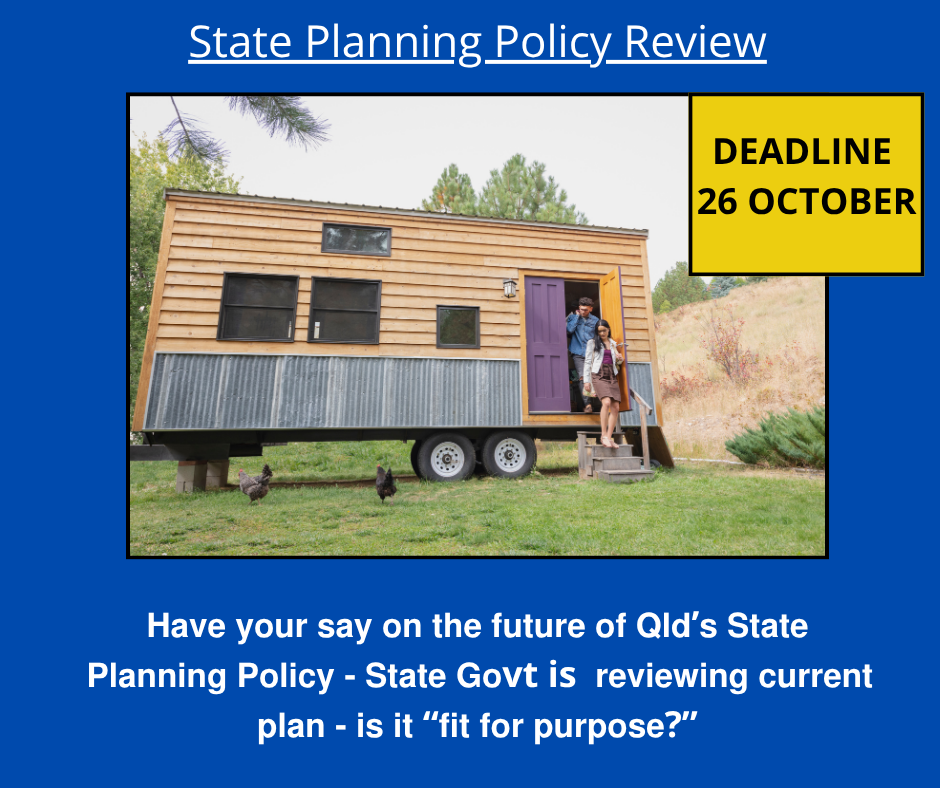
HAVE YOUR SAY
The State Planning Policy is a key part of Queensland’s planning framework. It sets out the state’s interests in land use planning and development and guides how local planning instruments are prepared and applied across Queensland.
The Queensland Government is reviewing the State Planning Policy to ensure it remains fit for purpose and responds to Queensland's future needs. The review seeks to improve the clarity, usability and efficiency of the planning framework while supporting housing delivery, economic growth and infrastructure investment.
Consultation on the draft State Planning Policy, the proposed changes to assessment benchmarks and natural hazards planning policy discussion paper is now open. Feedback is welcomed from local government, industry, community organisations and interested Queenslanders.
Consultation closes at 11.59 pm on Monday 26 October 2026.
HELP WITH YOUR SUBMISSION
Here at Tiny Community Living, we support alternative housing such as cooperative or co-housing and tiny homes on wheels. Your submission can address both, or either, of these housing types. We recommend including both housing types.
Using the template provided by Tiny Homes Expo, we have changed it to include both tiny homes on wheels and cooperative housing.
Who are you? Choose Community Member. If you represent a housing organisation, check that you can represent them in this submission.
What changes are of interest to you? Tick New State Aspirations and Other and write ‘State-level recognition of cooperative housing as a distinct tenure, and a state-level clear pathway for the long-term occupation of Tiny Homes on Wheels.’
Most crucial State interest - Tick Housing plus any others that are important to you.
What would show the policy has been successful? - Suggested selections: More homes in appropriate locations, faster and more efficient planning decisions and well-planned communities that meet local needs. If you choose other, you can include housing clusters that support the people living in the homes, intergenerational living and living collectively to support each other and build resilience.
Does the draft address the issues most important for Queensland’s future growth? - Your choice here.
What is missing from the State Planning Policy? This is your opportunity to share your story and why you want these changes. We need to communicate that land zoned rural should be used for cooperative housing and for landowners to host Tiny Homes on Wheels. As part of our submission, we asked that landowners be allowed to host more than one tiny home on wheels, depending on the size of the land. You can use our proposed local law as an example.
Personalise your message to your situation or your hopes.
Cooperative Housing examples:
"I am part of a group that wants to build or buy a home together as a cooperative, but I couldn't find a clear planning pathway. I want to build it on land zoned rural, but Council staff told me I can’t have more than one dwelling and a small secondary dwelling.”
"Our household wants to share land and facilities with other households under a cooperative structure. We can't work out whether this is treated as a dwelling house, multiple dwellings, rooming accommodation or something else."
"I live in a cooperative and worry that because planning schemes don't recognise us, our home could be treated as non-compliant if someone complains."
"I'd like to put my savings into a housing cooperative, but I can't find out whether the planning rules will let it go ahead. That uncertainty stops people like me from investing."
"Cooperative housing could give people like me an affordable, secure option that isn't renting or buying alone. I'm not asking for no regulation. I'm asking Queensland to create clear and proportionate rules."
“Queensland is lagging behind in creating opportunities for people to come together and create cooperative housing, especially on rural zoned land. This must change, as people want to live collaboratively, share meals, and support each other as our needs change.
Tiny Homes on Wheels examples (from Tiny Homes Expo)
“I currently live in a Tiny House on Wheels and worry that a neighbour complaint could mean I have to leave. I want a clear legal pathway for long-term occupation.”
“I contacted my Council about living in a Tiny House on Wheels and could not get a clear answer. I was referred between different rules and eventually gave up.”
“I want to buy a Tiny House on Wheels but I'm not prepared to invest my savings when I can't establish whether I will be allowed to live in it.”
“I have land and would like a family member to live in a Tiny House on Wheels on my property, but the current rules are unclear.”
“Tiny Houses on Wheels could give people like me another housing choice. I am not asking for no regulation — I am asking Queensland to create clear and proportionate rules for long-term occupation.”
Final Comments - Some examples that you can personalise. Submissions will be disregarded if they all look the same.
Option 1: Clear rules
Queensland needs clear, consistent planning rules for cooperative housing so people know where and how they can establish and live in a cooperative.
Queensland needs clear, consistent rules for Tiny Houses on Wheels so people know where and how they can legally live in them long term.
Option 2: Housing choice
Cooperative housing and Tiny Homes on Wheels can provide another genuine housing choice for Queenslanders, particularly for people locked out of both home ownership and the rental market. Please create a practical planning pathway.
Option 3: Recognition
Please recognise cooperative housing as a distinct housing model, rather than forcing it into definitions designed for single dwellings, rental properties or other forms of accommodation.
Please recognise Tiny Houses on Wheels as a distinct housing typology rather than trying to fit them into rules designed for conventional buildings or other forms of accommodation.
Option 4: Council confusion
Groups shouldn't have to approach Council after Council and receive different answers about cooperative housing and tiny homes on wheels. Queensland needs State-level guidance that gives councils and the community a clear pathway.
Option 5: The right regulation
I am not asking for these alternative housing types to be unregulated. I am asking for clear, proportionate regulation that recognises what cooperatives actually are and provides a pathway for them. Landowners who want to host people in tiny homes on wheels need clear regulation so they can get insurance and owners can obtain finance and insurance to cover their non-traditional home.
Option 6: Certainty before investing
The community needs to know whether a cooperative housing project can proceed BEFORE they commit their savings. They also need to know whether they can legally live in a Tiny House on Wheels BEFORE they spend their savings buying one. The current uncertainty needs to be addressed.
Option 7: Housing crisis
At a time when Queensland needs more housing options, groups willing to organise and fund their own homes shouldn't be stopped because planning policy doesn't recognise cooperative models. I know landowners who would happily host people in tiny homes if they had more certainty. More affordable housing is needed, so it is time to look at non-traditional housing options, as not everyone wants to live in a standard home.
Option 8: Very simple
Please give Queenslanders a clear and reasonable planning pathway for cooperative housing and the ability to live long-term in tiny homes on wheels.